What AI Companies Are Quietly Building in the Life Sciences
Short version: the AI labs have spent the past year building something other than chatbots for scientists. They are building the apparatus around the model: who is verified to use it, what it is allowed to do, which tools it can reach, what gets logged, and in at least one case, a physical laboratory to test the answers. The models are the headline. The apparatus is the investment, and it is the part that decides who gets to do this kind of science and how quickly.
The week that made it obvious
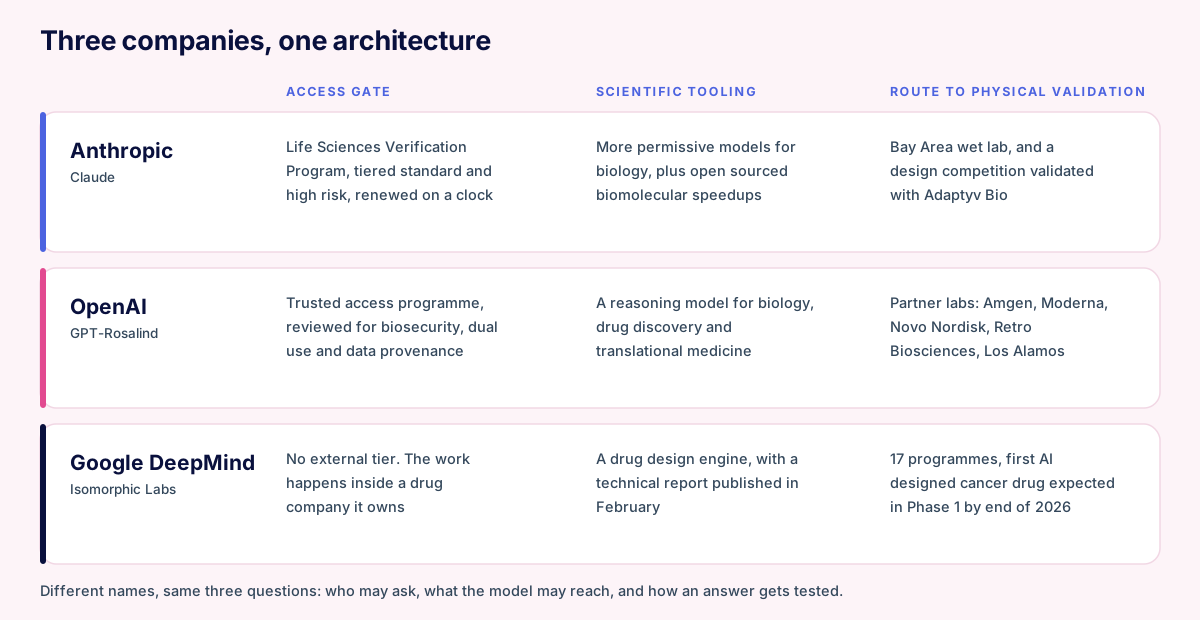
On 17 September, Anthropic opened applications for its Life Sciences Verification Program. Verified organisations get more permissive access to its models for drug discovery, research biology, clinical development and manufacturing, which is work the generally available models refuse. Access is tiered by risk: a standard tier for routine life sciences work that renews annually and can cover a team, and a high risk add on tied to one named project that renews every six months. Applicants are assessed on credentials, security standards and research oversight, and dozens of organisations had already been onboarded through early access.
The same week, Anthropic confirmed it runs a wet biology laboratory in the San Francisco Bay Area, connecting model work to physical experimentation rather than leaving it in simulation. It also reported that Claude had optimised more than 30 open source biomolecular modelling systems in under four weeks, for roughly a fourfold average speed improvement, plus a low memory mode that lets large systems run on a single GPU node. That code is open sourced, and it comes with a protein design competition co-sponsored with Adaptyv Bio, backed by up to a million dollars in credits and wet lab validation for more than 5,000 designs.
Also that week, LangChain released Deep Life Sci, an open source agent harness for clinical and laboratory scientists. It reads across 29 million PubMed abstracts, 12 million full text articles and more than 600,000 registered studies on ClinicalTrials.gov, runs analysis in a sandbox, delegates across hundreds of subagents, and takes the file types scientists work with: PDFs, tables, RIS bibliographies, SMILES and FASTA sequences, RNA-seq results, proteomics data. Every search, code execution and subagent hop is traced.
It is not one company
Anthropic was simply the loudest that week. The same build out is happening everywhere.
OpenAI released GPT-Rosalind, a reasoning model for biology, drug discovery and translational medicine, with early collaborators including Amgen, Moderna, Novo Nordisk, the Allen Institute and Thermo Fisher, plus work with Retro Biosciences and Los Alamos on protein and catalyst design. Access sits behind a trusted access programme with a qualification and safety review covering biosecurity, dual use research and data provenance. Different name, same architecture as Anthropic's tiers.
Google DeepMind's Isomorphic Labs has 17 programmes across oncology, immunology and cardiovascular disease, published a technical report on its drug design engine in February, and expects its first AI designed cancer drug in Phase 1 by the end of this year.
Three companies, three strategies, one shared conclusion: the frontier of this work is no longer only the model. It is verified access, specialist tooling, evaluation, and a route to physical validation.
What the labs are building
Strip away the branding and the same five components appear.
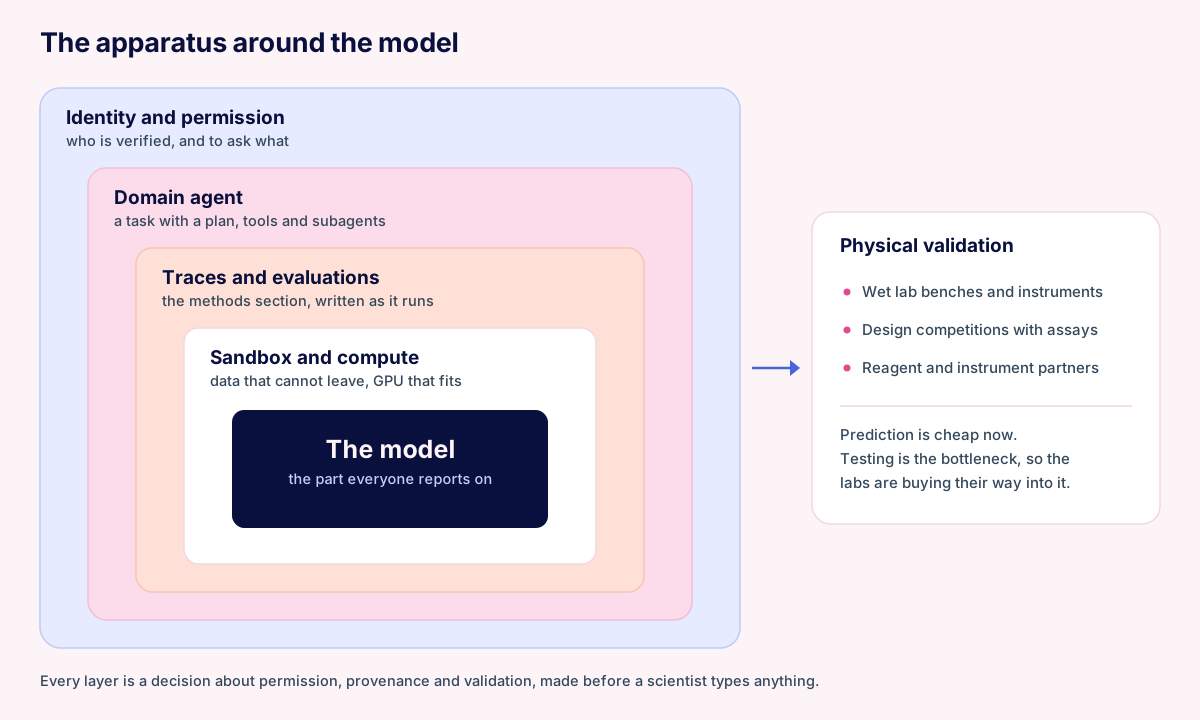
Identity and permission. Verification programmes decide who is allowed to ask what. Credentials, institutional affiliation, security posture and research oversight become inputs to a model's behaviour, not just to a purchase order.
Domain agents, not chat. Something that reads a literature corpus, runs code on your data, and delegates across subagents is a different product than a chat window. The unit of work is a task with a plan, not a message.
Traces and evaluations. Logs of what was searched, what ran, which documents were read and how the answer was reached. In science this is not compliance theatre, it is the methods section.
Sandboxes and compute. Analysis has to run somewhere isolated, on data that cannot leave, with enough GPU to matter. The low memory work is a reminder that a lab with one node is a constraint that shapes what gets run.
Physical validation. Wet labs, competitions with assays, partnerships with instrument and reagent companies. Prediction is cheap now. Testing is the bottleneck, so the labs are buying their way into testing.
What it changes for research
The gate moved. For years the question was whether a model could do useful biology. Now it can, and the question is whether you are verified to ask. That is a governance decision with scientific consequences, and it will shape who publishes what over the next few years.
Computational biology just got faster for everyone. A fourfold average speedup on open source biomolecular models, and a memory mode that fits large systems on one node, lands in every lab that uses those tools, verified or not. This is the most immediately useful thing to come out of the whole week and it needs no application form.
Provenance becomes part of the method. If an agent read 300 papers and ran your analysis, the trace is what a reviewer, a collaborator or a regulator will eventually ask for. Groups that keep those records will find it easier to publish, defend and reuse their work. Groups that do not will be reconstructing from memory.
Two tiers are forming. Verified institutions with security teams will move faster than independent researchers, smaller universities and labs outside the countries these programmes were designed around. Open source harnesses and open weights are the counterweight, which is why the open releases matter more than they look.
If you want to take part, start here
You do not need a verification programme to begin.
Use the open tools first. Pull the optimised biomolecular code and the Deep Life Sci harness, point them at a question you already care about, and see where they break. That is a week of work and it will teach you more than any launch post, this one included.
Enter the competitions. Adaptyv Bio designs go to wet lab validation, benchmark challenges, open evaluation sets. They are one of the few routes where an individual gets physical results without owning a bench.
Build the evaluation set nobody else can. Your domain knowledge is now infrastructure. A careful set of problems from your own field, with known answers and documented failure cases, is more valuable than another prompt library, and it is what every group adopting these systems is short of.
Get your institution in the queue. If you work somewhere with credentials and a security function, verification is an administrative task someone should already be doing. Find that person. The assessment covers credentials, security and oversight, so the work is mostly paperwork your institution has done before.
Keep the trace. Whatever you run, log what the system saw, which version it was, and how it got to the result. It costs little now and it is nearly impossible to reconstruct later.
What to decide now
The past year of AI in science was about capability. This one is about access, apparatus and validation. If the model stopped improving today, most labs still would not be using what already exists, because the environment around it is missing. That environment is what is being built right now, quietly, and it is worth deciding early whether you are going to be inside it or waiting on it.