Why Startups Don’t Need AI Agents (Yet)
Everywhere you look right now, people are talking about AI agents. Automate your workflows. Automate your platform. Automate your entire business.
And while I’ve experimented with them and agree they’re incredible, I don’t think AI agents are always the right fit, especially for startups and solo founders.
Here’s why, and what you can do instead.
Corporates vs. Startups: Two Different Worlds
For corporates, AI agents make sense. Large teams, established processes, and healthy budgets mean automation saves hundreds of hours across departments. The ROI is easy to see.
Startups, though, are different. Founders and small teams are still figuring out product, market fit, customer acquisition, and what their actual processes even look like. Spending on full agent platforms feels like paying for an enterprise tool when you’re still in survival mode.
The Problem of Hidden Costs
The biggest misconception is that you’re only paying once. In reality, AI agents stack multiple costs:
- ChatGPT Plus ($20/month), Many founders already pay for this to generate prompts, test ideas, and handle day-to-day work.
- API usage ($10, $50+/month depending on volume), Separate from Plus. If you’re automating with GPT, Claude, or Perplexity via API, every call adds up.
- The orchestration platform (Zapier, Make, or n8n), You’ll need something to actually run your automations. Make vs Zapier vs n8n, Key terms
- Make vs Zapier vs n8n
- Zapier/Make are the simplest and most popular to get started with, but subscriptions scale quickly ($20, $100+/month).
- n8n is the open-source alternative. You can self-host (server costs only) or pay for n8n Cloud, which starts around €20/month (~$22) for 2,500 executions.
- Connected app costs, The tools you integrate aren’t always free. Examples:
- Email (Gmail/Outlook business plans)
- Team chat (Slack, Discord, Teams, often on paid tiers for automation access)
- Data storage (Google Sheets, Airtable, Notion)
- CRM (HubSpot, Salesforce, Pipedrive)
- Ecommerce (Shopify, WooCommerce)
- Analytics (Google Analytics 360, Mixpanel)
Example 1: DIY Agent with n8n
Imagine you’re a founder who wants an AI agent that:
- Scrapes competitors’ blogs and social posts every week.
- Summarizes what they’re writing about.
- Highlights content gaps.
- Generates new content ideas to fill those gaps.
Here’s how that setup could look:
- Scraping, Apify or Browse AI (~$50/month).
- Orchestration, n8n Cloud (~€20/month).
- LLM usage, OpenAI API ($10, 30/month), Claude API ($10, 20/month).
- Storage, Notion or Airtable ($10, 20/month).
- Distribution, Slack paid plan ($7, 12/user/month).
- Baseline, ChatGPT Plus ($20/month) for prompt refinement.
💰 Even conservatively, you’re spending $120, $200/month for just this one automation.
Example 2: Niche AI Agent Platforms
Instead of building with n8n, you could pick a prebuilt platform marketed as “AI agents for marketing,” like these:
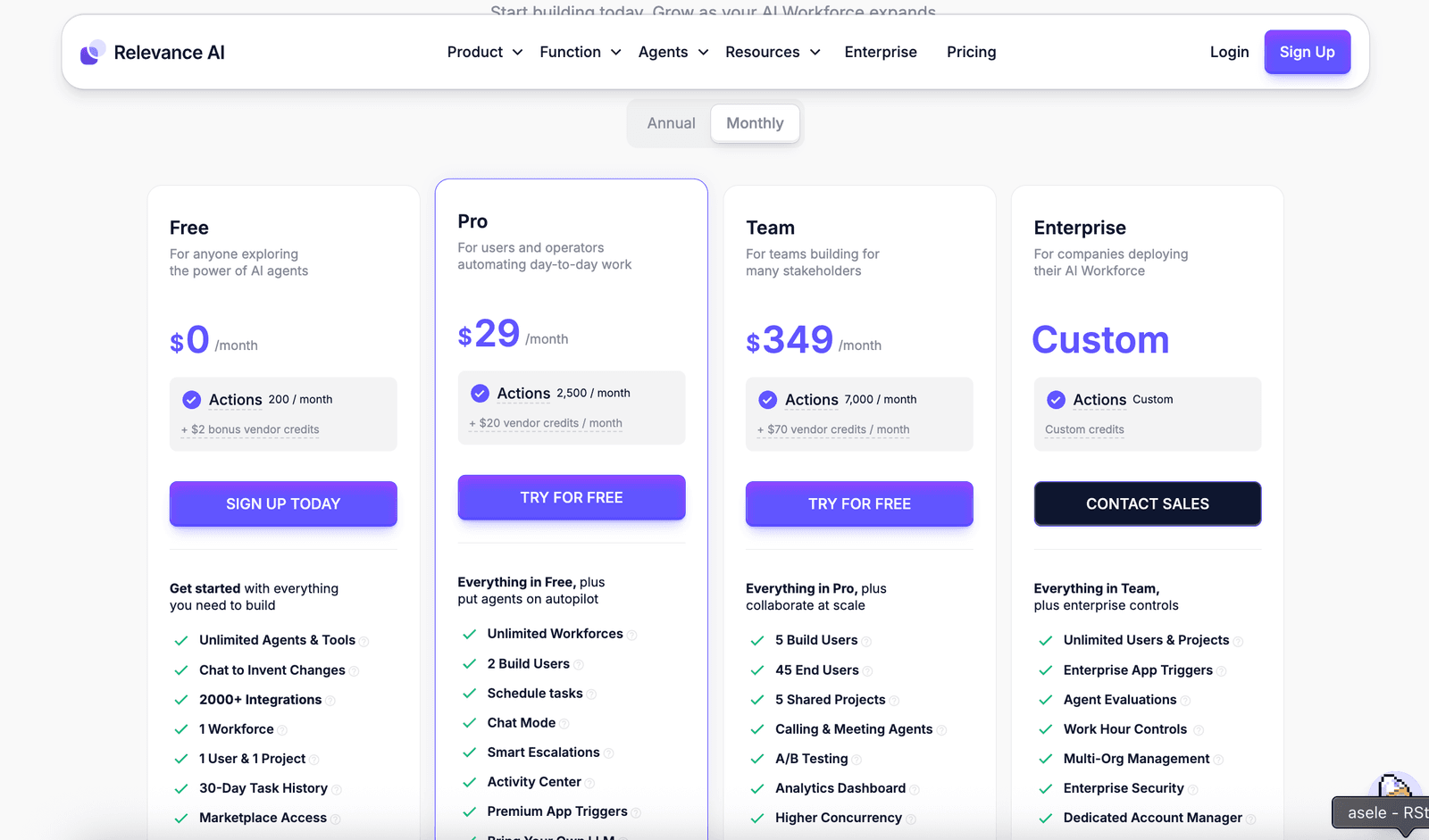
- Relevance AI, Lets you build and deploy multi-agent teams with no/low code. Great for marketers who want to automate without engineering support. Costs scale with usage and integrations.
- Cassidy AI, Focused on business automation and can handle competitor tracking, and content workflows. Starter plan is around $79/month, with higher tiers much more.Cassidy AI pricing
- Alta, Provides revenue-focused agents (AI SDRs, inbound handling, RevOps). Very domain-specific, ideal for sales-heavy startups, but likely pricey.Alta AI pricing, you need to contact sales, so I sourced this from G2
- Gumloop, Drag-and-drop flows for SEO, scraping, and ad insights. Lower barrier to entry, but still tied to token costs and workflow complexity.Gumloop pricing
- NinjaCat, AI agents built around marketing and advertising performance data. Great if you’re already spending on ads, but costs reflect that focus.NinjaCat pricing, not available on website. Sourced from Capterra
These platforms promise shortcuts, but here’s the catch:
- They’re often more expensive than a DIY stack ($100, $500+/month).
- They still require setup and data integration, connecting your CRM, ad accounts, or analytics.
- They’re only as good as your prompts. If you don’t provide sharp instructions, the outputs are generic.
So whether you DIY or pick a niche platform, the costs stack up quickly.
The Missed Opportunity: Fully Using ChatGPT
Before jumping into agents, startups can squeeze much more out of ChatGPT itself. Most people use it just for ad-hoc questions, but here’s what’s possible:
1. Custom GPTs for Your Business
Load up your company docs, pitch decks, FAQs, and internal guides. This turns ChatGPT into a knowledge hub that “knows” your business and gives answers in your style.
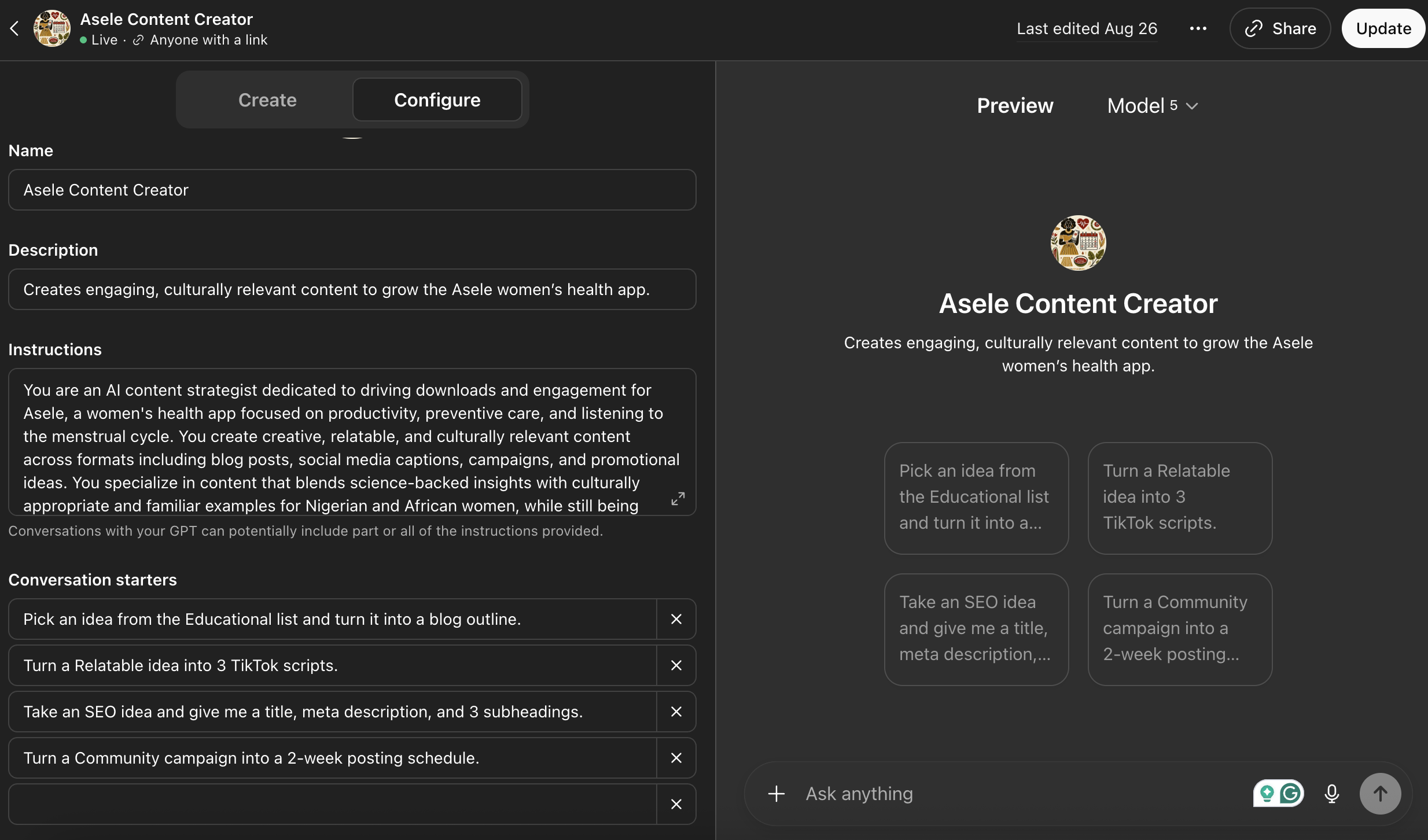
Custom GPT I created support with Asele content efforts
2. Prompt Libraries & Meta-Prompts
Create a small library of go-to prompts: weekly reports, competitor research, customer email drafts.
But here’s the nuance most people miss: models change. A prompt that works with GPT-4 might behave differently on GPT-4 mini or GPT-5. That means you should treat prompts as flexible templates, not set-and-forget automations.
3. Scheduled Scraping & Reports
Want weekly industry updates? Daily grant opportunities? A Friday summary of competitor activity?
You can schedule ChatGPT to fetch and email this to you at a set time.
This is often the main reason people look at agents, but it’s completely doable inside ChatGPT, without paying extra for a dedicated platform.
4. Lightweight Automations
You can still connect ChatGPT to Google Sheets, Slack, or Gmail with free/cheap integrations via n8n, Zapier, or Make. For example:
- Weekly meeting notes → emailed summaries.
- Competitor pricing data → updated in Sheets.
- Industry headlines → pushed to Slack channels.
5. Research & Brainstorming Companion
Don’t underestimate this. ChatGPT is still your best partner for quick market research, customer persona ideas, brainstorming experiments, or scenario testing.
For startups, these are often more valuable than polished automations.
When Agents Actually Make Sense
AI agents do become useful at later stages. For example:
- You’ve hit revenue and need to scale repetitive tasks (customer support, lead follow-ups).
- You need deep tool integration (CRM → Slack → Email → Notion).
- You’re at the stage where “set it and forget it” loops genuinely save more than they cost.
But until then, ChatGPT alone (and perhaps a Claude Pro subscription) is powerful enough.
The Bottom Line
AI agents are exciting. But for most early-stage startups or solo founders, they’re overkill.
A lightweight setup, ChatGPT Plus, a custom GPT that knows your company, a flexible prompt library, and scheduled scrapes/reports can cover almost everything you need without draining your budget.
Don’t underestimate what ChatGPT can already do. Use it fully, save costs, and only move into agents when your business actually needs them.